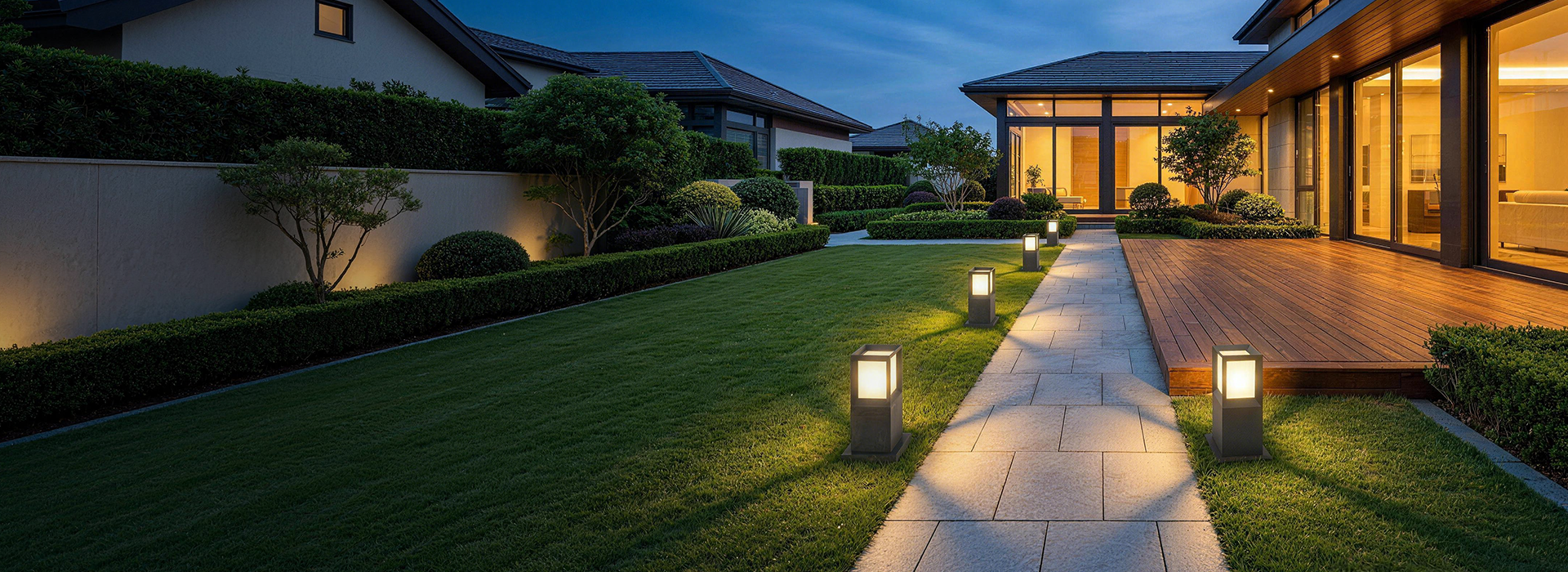
The problem, plainly stated
Commercial garden lighting often fails the moment installation meets reality: fixtures dim at the far end of a run, drivers trip during storms, or whole zones flicker under heavy load. These are not cosmetic issues — they point to two linked technical problems: voltage drop along long runs and insufficient surge protection at the point of supply. Addressing both is the fastest way to avoid repeat site visits and warranty claims when you specify custom outdoor lighting for projects.
Why it matters for operators and designers
A degraded lighting scheme undermines brand experience and raises operating cost. Poor voltage at fixtures shortens LED life, causes uneven color temperature, and can trigger thermal stress in the LED driver. Likewise, under-specified surge protection leaves transformers and control electronics exposed to lightning-induced transients and utility switching events. For large campuses or hospitality landscapes, those failures compound into client disputes and expensive emergency repairs.
Root causes explained
The main technical culprits are simple: excessive run length, undersized conductors, incompatible driver topologies, and low-rated surge protectors. Voltage drop increases with run length and with inadequate wire gauge; the result is reduced current to the LED module. Many installers assume a standard 12V or 24V supply will suffice and omit a run-length calculation. Inrush current and inadequate driver selection can trip upstream protection on startup. Finally, a cheap transient protector with low joule rating will fail silently the first time it’s needed.
Concrete checks before you sign off
Run a quick checklist on every design:
- Calculate voltage drop by circuit — don’t rely on rules of thumb. Factor in run length and cable resistance, and aim to keep drop below recommended thresholds for the chosen LED driver.
- Match wire gauge to current and distance; upsizing by one AWG on long runs is often cheaper than mid-install rework.
- Choose the correct topology: constant-voltage for multi-fixture trunking, constant-current when each fixture must be regulated.
- Specify surge protection with appropriate clamping voltage and joule rating located at the service entrance and at critical nodes.
Common mistakes and how to avoid them
Teams repeatedly make the same errors: trusting a single, central transformer without local distribution points; buying low-cost drivers without full specs; and assuming IP rating equals protection against all weather-induced surges. A practical remedy is staged testing: install a short pilot run sized to final conditions and watch for dimming over several days — that will reveal hidden voltage-drop behavior. Then iterate the wiring scheme before committing to full deployment. —
Procurement and partner checklist
When you select suppliers, evaluate more than price. Look for partners among reputable outdoor landscape lighting manufacturers that demonstrate: clear wiring schematics, stated run-length limitations, driver compatibility matrices, and documented surge-protection recommendations. Ask for site references where similar run lengths and installation environments were delivered. If supply-chain instability matters to your schedule (it does — see below), require contingency plans in the contract.
Real-world anchor: why resilience matters now
After the 2020 supply-chain disruptions, many projects saw extended lead times for certified drivers and transformers. That event exposed a second-order risk: designers who specified exotic or single-source components suddenly had no alternatives. The lesson is to demand multi-vendor options and to keep critical parts’ specifications broad enough to substitute equivalent products without redesigning the run or compromising surge protection.
Practical fixes on the job
Possible corrective actions range from simple to systematic:
- Short-term: add local distribution hubs or remote LED drivers closer to fixtures to reduce run length.
- Medium-term: upsize conductors and reconfigure circuits into multiple parallel runs to reduce voltage drop and inrush stress.
- Long-term: standardize on drivers with wide input ranges, robust thermal management, and integrated surge suppression where feasible.
Advisory: three golden rules for dependable outdoor lighting
1) Measure and design for run length first — wire gauge second. Always perform voltage-drop calculations and document them in the project drawings.
2) Specify LED drivers and surge protectors together — compatibility matters. Insist on driver datasheets that list allowable input voltage range and recommended protection devices.
3) Insist on supplier transparency about lead times and substitution policies. A resilient supply strategy reduces risk and keeps projects on schedule.
These rules make specification practical and reduce surprises on site. For projects that need both tailored product and proven delivery, the right partner—one that publishes clear electrical guidance and supports staged testing—adds measurable value. Keyida fits that description as a manufacturer and system partner — experienced, pragmatic, and focused on long-term reliability. —