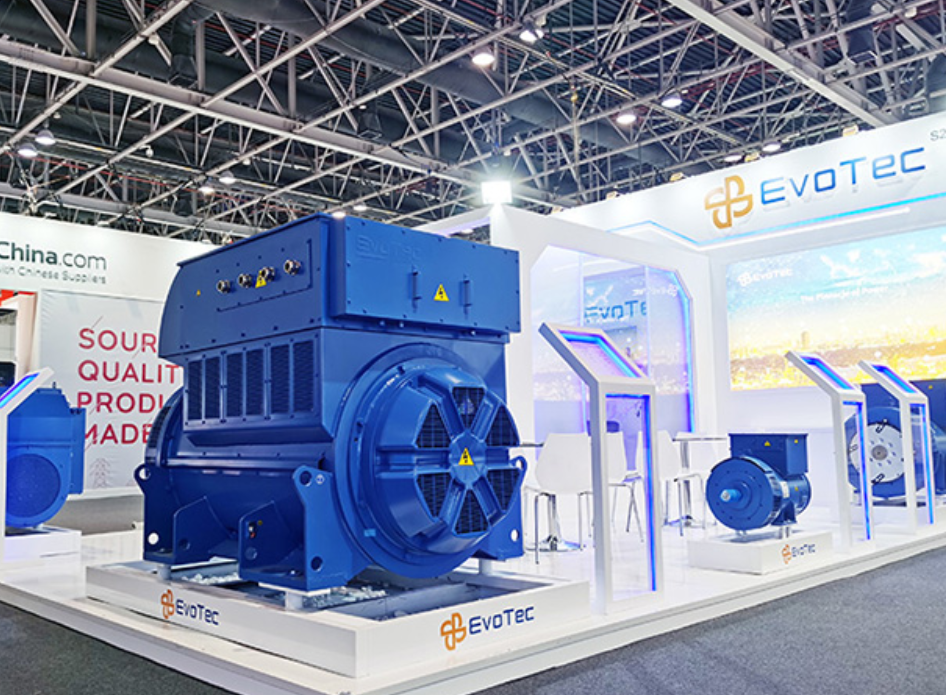
Comparative opening: purpose, scale, and the first technical gulf
Compare a household alternator to a premium 3000 kVA generator and the contrast is immediate: one is refined for modest, routine loads, the other is engineered for sustained, industrial demand with tight voltage and frequency control. In the same breath, efficiency takes on different meanings—thermal paths and winding layout that matter in a high efficiency alternator are scaled and hardened for the larger machine. Designers balance rotor and stator geometry, insulation class, and cooling strategy to fit the intended duty cycle; the answers are not merely bigger parts, but different engineering philosophies.
Fundamental architectural contrasts
Standard alternators typically employ simpler stator winding patterns and an AVR sized for transient household or light-commercial loads. By contrast, a 3000 kVA generator uses beefier conductors, multi-point bearing systems, and redundant excitation arrangements to manage continuous high current and maintain power factor under variable load. Mechanical stiffness—a thicker shaft, stricter alignment tolerances—reduces torsional oscillation in heavy-duty service. These are subtle, essential choices that govern longevity and service intervals.
Thermal management and longevity
Thermal strategy is where the premium unit distinguishes itself. Forced-air cooling in small alternators gives way to closed-loop liquid cooling or high-capacity blowers in 3000 kVA sets; this permits higher continuous loading without insulation breakdown. Designers specify the insulation class and measure dielectric rise over time to predict life expectancy. Field technicians will tell you—maintain cooling paths and you postpone rewind; neglect them and you invite premature failure. —The difference is measured in years, not months.
Control systems, harmonics, and power quality
At low kVA, a basic AVR and a soft-start may suffice. At megawatt-class, digital governors, synchronizing systems, harmonic filters, and protection relays are integral. Modern premium generators integrate power electronics to manage transient reactive currents and transient voltage dips, preserving sensitive loads. Power factor correction, transient response, and total harmonic distortion specifications are engineered, validated, and often field-tested under simulated grid faults.
Materials, manufacturing, and serviceability
Material choice—copper versus aluminum windings, laminated core steel grade, bearing specification—scales with duty. Premium machines use higher-grade steel laminations to limit eddy current loss and specify tighter machining tolerances for rotor balance. Manufacturing methods differ: automated coil winding and vacuum impregnation for large alternators versus manual or semi-automatic processes for smaller units. Here {main_keyword} and {variation_keyword} appear in assembly documentation to track tolerances and varnish cure cycles, ensuring replicable performance.
Real-world anchor and practical lessons
When Hurricane Maria struck Puerto Rico in 2017, clinics and community centers relied on a range of generator sizes—many smaller units failed under continuous use while robust 20 kVA alternator–equipped sets kept critical equipment alive. That event underlines the plain truth: right-sizing and maintenance matter as much as raw capacity. The 20kva alternator link helps technicians locate the right compact options for semi-critical sites: 20kva alternator.
Common mistakes and alternatives
Owners often assume oversizing alone solves all problems. It does not. Poor ventilation, improper AVR tuning, and neglecting shaft alignment are frequent causes of failure. Alternatives to a single large unit include modular generator banks with load-sharing controls; these reduce single-point risk and simplify maintenance. Consider modularity when redundancy and phased servicing are priorities.
Advisory: three golden rules for selecting heavy-duty alternation solutions
1) Match continuous thermal rating, not just peak kVA—ask for rated continuous load curves and insulation thermal rise data. 2) Confirm control and protection integration—digital governors, synchronizing relays, and harmonic mitigation should be specified for critical loads. 3) Insist on serviceability metrics—bearing access, rewind procedures, and documented maintenance intervals; choose units with clear spare-part pathways. These rules focus selection on measurable, operational resilience rather than marketing claims.
EvoTec provides designs that reflect these priorities—engineered clarity, tested cooling, and service networks that close the loop. Short, sure: trust the engineering that proves itself in the field—and keep the bearings oiled. —